
EFSA Updates: New Safety Principles for Food Contact Materials
or complex compliance issues.
clearance and fund security.
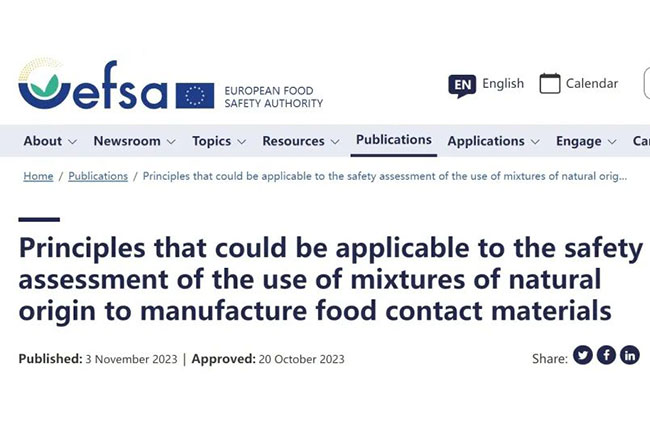
In November 2023,the European Food Safety Authority (EFSA) published a scientific opinion titled Principles for the safety assessment of natural - origin mixtures used in food contact materials in its journal EFSA Journal.This document not only represents an important advancement in the field of food safety but also provides new guiding principles for the safety assessment of natural - origin mixtures in food contact materials.
I.Definition of natural - origin mixtures and their applications in food contact materials
With the popularization of the concept of sustainable development,more and more food contact materials and products are starting to use renewable biological resources from non - fossil sources.These resources mainly come from plants,and a small part may come from animals.Common forms include single substances or simple mixtures,and more often complex uncharacterized mixtures.
II.Safety assessment principles and key considerations
Based on its previous assessment experience of novel foods,food enzymes,etc.EFSA has developed a series of safety assessment principles,focusing on the following aspects:
Substance characteristics and source information: Detailed information on plant species,cultivation,storage,physical and mechanical processing processes is required.
2.Analysis of the composition of small molecule substances: For low - molecular substances with a molecular weight below 1000 Da,comprehensive composition analysis is required.
3.Migration testing and toxicological assessment: Special attention is paid to the use of additives,as well as the migration amount and potential toxicity of these additives.
III.Specific case analysis
EFSA takes three different substances from natural sources as examples to clarify the key points to be noted in the risk assessment:
1.Untreated wood powder and fibers (FCM No 96): It has been removed from EU regulations,and more additional information is required,including plant species,processing processes,and the use of additives.
2.Crushed sunflower seed husks (FCM No 1060): It focuses on the risk assessment of small - molecule impurities in the substance.
3.Bleached cellulose pulp: The focus is on the migration of low - molecular substances and a comprehensive safety assessment.
IV.Precautions for new substance applications
When applying for new natural substances for food contact,enterprises should refer to the latest guidelines issued by EFSA and comprehensively prepare application materials.This includes comprehensive composition analysis data,specific migration tests,toxicological assessments,and relevant information on substances produced by QPS microorganisms.
Was this helpful? Give us a like!
Contact our experts for compliance audits, precise quotes, and one-stop customs support.
Recent Comments (0) 0
Leave a Reply