
EU Food Contact Plastic Reg Changes: Key Updates
or complex compliance issues.
clearance and fund security.
On July 12,2023,the European Commission issued the amending regulation (EU) 2023/1442 of the plastic regulation (EU) 10/2011 for food contact.The main amendments include revoking two permitted substances,tightening the requirements for phthalate plasticizers,modifying the use requirements of permitted substances and adding new permitted substances.The new regulationcame into force on August 1,2023.
Revoke two permitted substances
The new regulation revokes the permission of FCM substance No.96 (untreated wood flour and wood fibers) and FCM substance No.121 (salicylic acid,CAS No0000069 - 72 - 7).
Tighten the requirements for phthalate plasticizers
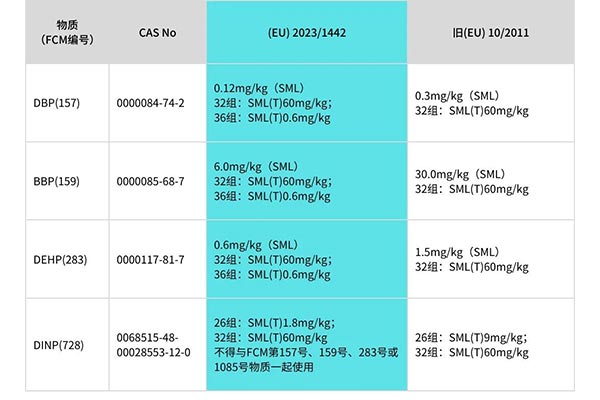
Stricter restrictions have been imposed on DBP,BBP,DEHP,and DINP,with substance FCM1081 added to Group 7.
The SML(T) limit of Group 26 is reduced from 9mg/kg to 1.8mg/kg.
Substances FCM1078 and 1085 are added to Group 32.A special note is made on the use of DIBP of substance FCM1085: DIBP is not listed as a permitted substance in Table 1 of Annex I of Regulation (EU) No10/2011.Since it is used as a polymerization aid,it may co - exist with other phthalates.Therefore,DIBP is included in the restrictions of Group 32.
Three new group numbers from 36 to 38 are added,and the calculation formula and limit of the sum of four phthalates (DBP,BBP,DEHP and DIBP) are specified.The sum is calculated as DEHP,and the calculation formula is: DBP×5 + DIBP×4 + BBP×0.1+DEHP×1,SML(T)=0.6mg/kg.


Transitional provisions
1.The new regulations will come into effect on August 1,2023.Plastic materials and products that comply with the (EU) Regulation 10/2011 applicable before the new regulations take effect,and are first placed on the market before February 1,2025,can continue to be sold on the market until their inventories are exhausted.
2.For plastic materials and articles made from salicylic acid (FCM121) or untreated wood powder and fibers,there are special transition period provisions.Under certain conditions,they can continue to be first placed on the market after February 1,2025.
- BeforeAugust1,2024,alicenseapplicationforthissubstancehadbeensubmittedtothecompetentauthorityinaccordancewithArticle9ofRegulation(EC)No1935/2004;
- Plasticmaterialsandarticlesmanufacturedusingthissubstancearelimitedtotheintendeduseconditionsstatedintheapplication;
- TheinformationprovidedtotheauthorityinaccordancewithArticle9(1)(b)ofRegulation(EC)1935/2004includesastatementindicatingthattheapplicationismadeinaccordancewiththisparagraph;
- Theauthorityconsiderstheapplicationtobevalid.
Was this helpful? Give us a like!
Contact our experts for compliance audits, precise quotes, and one-stop customs support.
Recent Comments (0) 0
Leave a Reply