
Korea Cracks Down on Seafood Origin Label Violations
or complex compliance issues.
clearance and fund security.
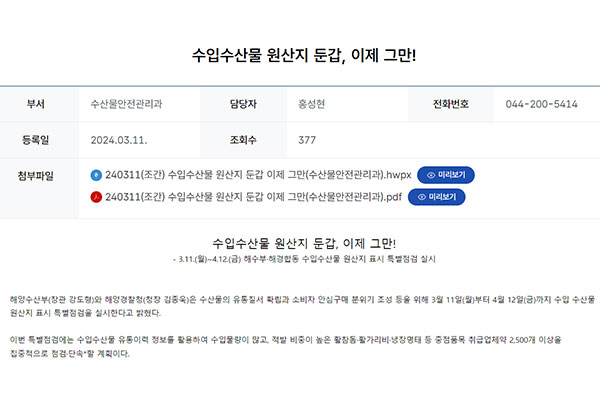
On March 11,2024,the South Korean Ministry of Oceans and Fisheries issued a press release announcing that it would join forces with the Coast Guard to conduct a joint inspection of the origin labels of imported aquatic products from March 11 to April 12,in order to crack down on illegal labeling of the origin of imported aquatic products.
Background and Objectives:
South Korea has always been paying continuous attention to food safety and trade integrity issues.In recent years,with the impact of Japans nuclear wastewater discharge and the continuous growth of imported aquatic products in the South Korean market,the accuracy of origin labeling has become increasingly important.Correct origin labeling is not only related to food safety,but also involves consumer rights and the integrity of international trade.Illegal labeling behavior not only misleads consumers,but also undermines market fairness and threatens public health.Therefore,the South Korean government has decided to take action and intensify its efforts to crack down on such illegal behaviors.
Implementation Details:
The target of this special inspection is to review aquatic products with a large import volume and a high inspection ratio.Specifically,this inspection will focus on key varieties such as live red snapper,live scallops,and chilled Alaska pollock.During the inspection,the circulation history information of imported aquatic products will be used to conduct a centralized review of more than 2,500 related enterprises.
The inspection content is not limited to the origin labeling of products,but also includes the compliance of all links such as product import,storage,and sales.Any discovered illegal behavior will be punished in accordance with relevant regulations.This action aims to discover and correct illegal behaviors through centralized inspection,and then improve the compliance level of the entire industry.
Regulatory Provisions and Rules:
According to relevant South Korean laws,for the act of falsely declaring the origin,a prison term of not more than 7 years or a fine of not more than 100 million won can be imposed.This shows the South Korean governments tough attitude towards such illegal acts.For products that do not clearly mark the country of origin,the penalty standard is a fine of 50,000 won to 10 million won,and the specific amount is determined according to the severity of the illegal act.
In addition,the South Korean government may also take other measures,such as suspending or revoking the business licenses of illegal enterprises,banning the sale of illegal products,etc.to enhance the deterrence of penalties.
Through this strict inspection and law - enforcement action,the South Korean government has demonstrated its firm commitment to food safety and trade integrity.This not only helps to protect the rights and interests of consumers,but also helps to promote a more fair,transparent and healthy international trade environment.
Announcement Text:
Was this helpful? Give us a like!
Contact our experts for compliance audits, precise quotes, and one-stop customs support.
Recent Comments (0) 0
Leave a Reply