
US Russia Sanctions: Export Controls & Economic Impact
or complex compliance issues.
clearance and fund security.
Against the backdrop of the Russia-Ukraine conflict,how exactly does the United States implement its control and sanction measures against Russian and third - country enterprises?And what far - reaching impacts do these measures have on the global economic and political landscape?In 2023,the United States significantly expanded the scope of its export controls on Russia by further amending the Export Administration Regulations (EAR),and focused its efforts on industries closely related to Russias military and national defense activities.This series of measures not only deepened the economic sanctions against Russia but also posed unprecedented challenges to global trade partnerships.
I.Legislative Trends of US Controls and Sanctions against Russia in 2023
(I) Legislative Trends of Export Controls
In the export control legislation actions of the United States in 2023,the regulatory concept of combining general control and precise targeting was clearly demonstrated.Through two amendments to the EAR,the United States not only significantly expanded the scope of export - controlled items to Russia,including a wide range of items from engines to toasters,but also specifically focused on controlling high - priority items related to Russias military and national defense.
Amendment to the Export Administration Regulations (EAR)
Through two important amendments to the Export Administration Regulations (EAR),the United States significantly expanded the scope of export - controlled items to Russia.These amendments specifically include:
Expansion of the Scope of Controlled Items:
In the 2023 amendments,the United States not only expanded the export control scope of dual - use items to almost all items in the Commerce Control List (CCL),but also specifically increased the control of purely civilian mechanical equipment and instruments.For example,all items under Chapters 84,85,and 90 of the US Customs Code,including various machinery and mechanical equipment,electrical machinery and its components,optical,photographic,measuring,medical,and surgical instruments,etc.were included in the controlled scope.
Expanding the Concept of "Luxury":
The United States has classified certain everyday communication devices and household appliances exceeding specific value thresholds—such as laptops,smartphones,hair dryers,household microwaves,and bread makers—as "luxury goods" and imposed export controls on them.
Definition of Items Using Customs Codes:
In order to enhance the convenience of control measures and international coordination,the United States adopted the more common international customs code method to define controlled items.This approach reduced the difficulty for enterprises to identify controlled items,but at the same time increased the amount of compliance review work that enterprises need to carry out before export.
2.Concentrate efforts on cracking down on "high-priority items."
In its export controls on Russia,the United States particularly emphasizes strict oversight of "high-priority items." These items are primarily closely related to Russia’s military capabilities and defense activities,including but not limited to:
Items Related to Drone Manufacturing:
For example,radio equipment,processors and controllers,memories,amplifiers,integrated circuits,etc.which are crucial for the manufacturing of drones.
Electronic Components:
Electronic components that play a key role in the production of Russias advanced precision - guided weapon systems were listed as the highest priority,and transactions related to these items were clearly identified as the key monitoring objects of US regulatory authorities in the future.
(II) Legislative Trends of Economic Sanctions
In terms of economic sanctions,the United States further increased the coverage of sanctions against Russia by issuing new executive orders and decisions and expanding the scope of general licenses.In particular,the secondary sanction risks for non - Americans are constantly increasing,indicating the United States comprehensive crackdown on the Russian economy and the sanction pressure on global partners.The continuous expansion of the industry sanction map,especially the increase in secondary sanction risks in the financial industry,has brought greater uncertainty to the global financial market.

II.Law Enforcement Observations of US Controls and Sanctions against Russia in 2023
(I) Increased Activity in Industry Sanction Law Enforcement
In 2023,based on the sanctions regulations against Russia,the United States included a large number of entities closely related to Russias military and national defense activities in the SDN list,especially in the industrial manufacturing,electronics,technology,finance,national defense,and aviation industries.According to statistics,the sanctioned third - country entities are mainly distributed in Cyprus,the UAE,Turkey,China (including Hong Kong),Singapore,Sweden,the UK,etc.For third - country entities other than Russia,US law enforcement departments pay more attention to the situation where they transship controlled items to Russia,enabling Russian entities to evade control.Judging from the cases,third - country entities operating in the technology and electronics industries are most likely to be sanctioned by the United States; in addition,third - country entities operating in the aviation and financial services industries also have relatively high sanction risks.
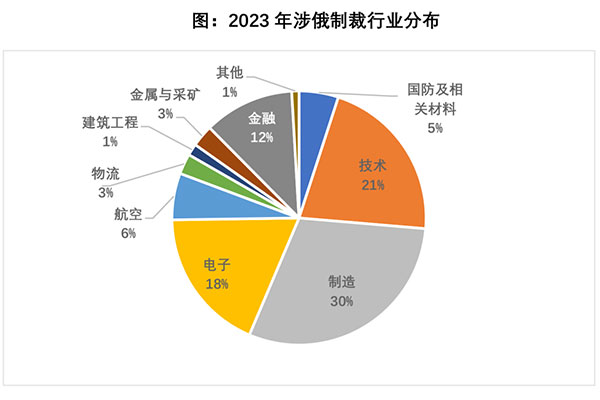
(2) Establish a "Disruptive Technology Strike Team" to enhance law enforcement coordination.
The frequency of interactions between the U.S.OFAC and other law enforcement agencies has increased,and the establishment of the "Disruptive Technology Strike Force" demonstrates the U.S.determination to combat Russia’s acquisition of advanced technologies.This enhanced interagency law enforcement coordination provides stronger safeguards against the illegal acquisition and utilization of U.S.advanced technologies,particularly in preventing their diversion to Russia.
(III) Frequent Issuance of Guidance Documents to Intensify the Crackdown on Sanction - Evasion Behavior
US regulatory agencies have significantly increased their crackdown on sanction - evasion behavior.By frequently issuing guidance documents,they have sent a strong anti - evasion law enforcement signal to the global market.This indicates that the United States will continue to increase sanctions against Russia and third - country enterprises that assist Russia in evading sanctions,and strengthen the supervision and crackdown on sanction - evasion activities.

Overall,the U.S.control and sanctions against Russia in 2023 undoubtedly exacerbated global political and economic tensions,and had a profound impact on international trade and financial markets.The sanctions and enforcement efforts against Russia are only second to those against countries subject to comprehensive sanctions such as Iran and Syria.In 2024,the U.S.presidential election year will arrive,and it remains to be seen whether the U.S.’s attitude toward sanctions against Russia might change.For Chinese companies,as European and American companies are withdrawing from the Russian market under the backdrop of sanctions,opportunities and challenges coexist in their Russian operations.
Was this helpful? Give us a like!
Contact our experts for compliance audits, precise quotes, and one-stop customs support.
Recent Comments (0) 0
Leave a Reply