
Understanding FCA Incoterms: A Guide for Buyers & Sellers
or complex compliance issues.
clearance and fund security.
What is FCA?
FCA stands for Free Carrier.Translated into Chinese,this term means delivered to carrier.Typically,the exporter delivers the goods to a specified location,where a designated carrier,appointed by the importer,will collect them.Of course,the exporter is responsible for handling export customs clearance procedures during this process.Once these procedures are completed and the goods are delivered,the transaction is considered finalized.Therefore,this mode is highly advantageous for exporters,as it significantly reduces the risks they bear when delivering goods under FCA terms.

Sellers obligations under FCA
Sellers obligations
The exporter must provide the goods as stipulated in the contract,along with a commercial invoice or equivalent electronic information,and any other documents required to prove the goods compliance with the contract.
The exporter must bear the risks and obtain export licenses or other official approvals,as well as complete all necessary customs procedures for export.At the specified location or other delivery point,the exporter must deliver the goods to the carrier or another person designated by the importer within the agreed time or period,using the agreed method or customary practices for the location.The exporter assumes all risks of loss or damage to the goods until delivery is completed.
Buyers obligations under FCA
Buyers obligations
The buyer must arrange transportation and fully notify the exporter of the carriers name,transport vehicle,and delivery time and location.From the moment the exporter delivers the goods,the buyer assumes all risks of loss or damage.The buyer must obtain import licenses or other documents,complete all customs procedures if required,and pay any related fees or transit charges.The buyer must accept the delivery document or equivalent electronic information and pay the price as stipulated in the contract.
This article link: | | |
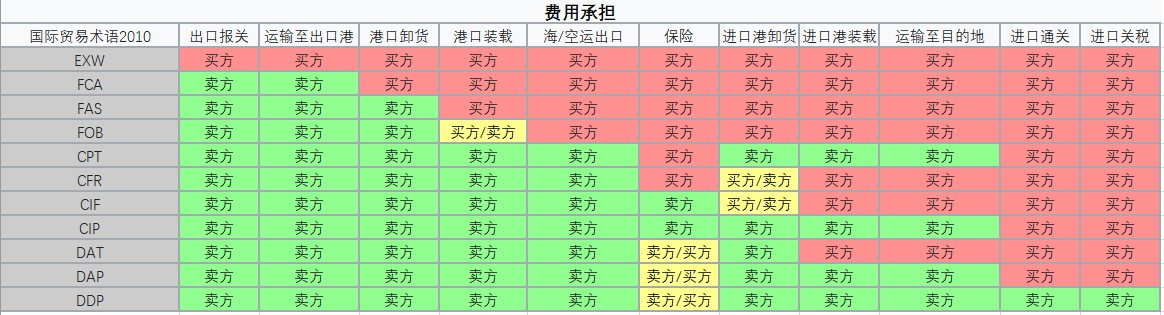
List of Parties Responsible for Costs between Buyers and Sellers under Various Trade Terms
Was this helpful? Give us a like!
Contact our experts for compliance audits, precise quotes, and one-stop customs support.
Recent Comments (0) 0
Leave a Reply