
EXW Payment Risks: Secure Your International Trade
or complex compliance issues.
clearance and fund security.
In international trade,both parties to a transaction often need to face various complex transaction terms and risks.The EXW (Ex Works) term is one of the common trade terms.It defines the time and place of goods delivery,as well as the responsibilities and risks of the buyer and the seller.However,when a customer proposes to conduct a transaction under the EXW term and requests installment payments,the seller may face significant risks.This article will explain the risks of paying according to the customers EXW - term requirements in international trade,and how the seller should respond to these risks to ensure the security of the transaction.
Risk Analysis under the EXW Term
According to the International Commercial Terms (Incoterms),the EXW term means that the seller only needs to prepare the goods and place them at its own premises (such as a factory,warehouse,etc.) for the buyer to collect.Once the buyer or its designated third - party takes possession of the goods,the risk is transferred to the buyer,and the sellers liability ends.Under this term,the buyer is responsible for all costs and risks from the sellers warehouse to the destination,including transportation,loading and unloading,and customs clearance.
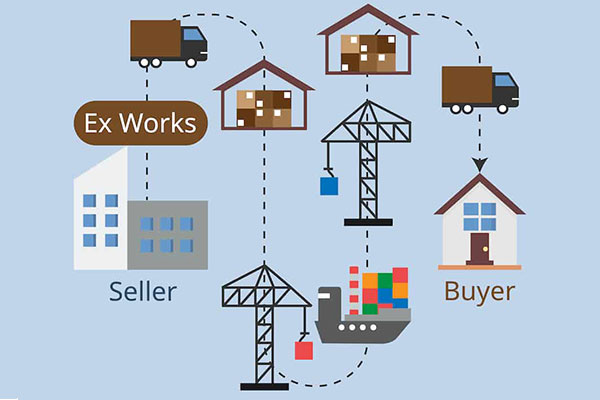
When a customer requests to conduct a transaction under such a term and proposes to pay 50% of the advance payment first,and the remaining 50% after the goods arrive at the port of destination,the seller will face significant risks.First of all,once the goods leave the sellers warehouse,the seller loses control of the goods,and at this time,the balance has not been received.If the buyer or its freight forwarder refuses or delays paying the balance after the goods arrive at the destination,it will be very difficult for the seller to take effective measures to recover the goods or demand payment of the balance.
In addition,since under the EXW term,the freight forwarder is designated by the buyer,and the counterparty of the contract is the buyer rather than the seller,the seller cannot control the transportation and delivery process of the goods.This means that if there are problems during transportation or customs clearance,it is difficult for the seller to intervene and solve them,increasing the uncertainty and risks of the transaction.
Response Strategies and Suggestions
Facing these potential risks,the seller needs to take a series of measures to protect its interests.First of all,the seller should try to avoid accepting the request for installment payments without sufficient trust.If the customer has a high credit rating and a long - term and stable cooperative relationship,the seller can consider accepting installment payments,but should try to shorten the time for paying the balance and require correspondingor guarantees.
Secondly,the seller should require the signing of a detailed written contract,and clearly stipulate the delivery conditions of the goods,payment terms,liability for breach of contract,etc.in the contract.In this way,once a dispute occurs,the seller can take legal action based on the contract terms.At the same time,the seller should also require the customer to provide as much information as possible,including the contact information and background of the freight forwarder,so that it can communicate with the freight forwarder when necessary.
In addition,the seller can also consider using other international trade terms,such as FOB (Free On Board) or CIF (Cost,Insurance and Freight).These terms require the seller to assume more responsibilities,but relatively,the seller can better control the transportation process of the goods,thus reducing risks.
In international trade,paying according to the customers EXW - term requirements,especially when the customer requests installment payments,indeed poses significant risks.The seller needs to conduct a full credit assessment of the trading partner and reduce risks by signing strict contracts,choosing appropriate transaction terms,and requiring appropriate payment guarantees.Only in this way can the seller protect its rights and interests while promoting the smooth progress of international trade.
Was this helpful? Give us a like!
Contact our experts for compliance audits, precise quotes, and one-stop customs support.
Recent Comments (0) 0
Leave a Reply