
US Toy Safety Regulations: CPSIA & ASTM F963 Guide
or complex compliance issues.
clearance and fund security.
Selling toys in the U.S.is not just about production and sales; it involves a series of regulations and standards.These regulations and standards aim to ensure toy safety and prevent harm to children.Below,we will detail the regulations and standards that must be followed when selling toys in the U.S.
Regulatory Requirements:
Every toy sold in the United States must comply with the Consumer Product Safety Improvement Act (CPSIA).This is a federal regulation established by the U.S.Consumer Product Safety Commission (CPSC).According to this regulation,all childrens products must undergo testing by a CPSC-accredited third-party laboratory to ensure they meet the safety requirements for childrens products.Once tested,the toy will receive a Childrens Product Certificate (CPC).
The definition of a toy is broad,covering almost all products designed for children aged 14 and under.This means that whether it is a traditional doll or a complex electronic game,these regulations must be followed.
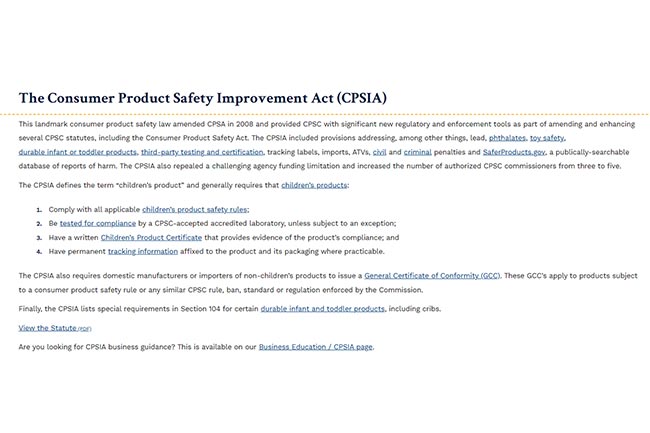
Specifically,toys must meet the following standards:
(1) Complies with CPSIA mandatory toy standard ASTM F963-17
(2) Complies with CPSIA Section 101 lead content requirements and 16 CFR 1307 phthalate testing requirements
(3) Toys with remote controls must comply with 47 CFR Part 15 requirements.
(4) If the toy includes batteries,it must also comply with the battery regulation Public Law 104-142.
Labeling and Warning Requirements:
Toy safety is not just about the toy itself; it also involves the packaging and labeling.According to the U.S.Toy Safety Standard ASTM F963,toys must clearly indicate the minimum recommended age.This means that if a toy is designed for children aged 3 and above,its packaging must clearly state this.
Additionally,ASTM F963 specifies a series of warning labels for specific toys,such as aquatic toys,crib and playpen toys,and activity toys.These warning labels provide important information about toy usage,helping consumers make informed purchasing decisions.
Product Traceability Information Requirements:
Traceability information is another critical aspect of ensuring toy safety.Every toy must have a traceability label containing the manufacturers name,production date,production location,and other relevant information.This information helps consumers understand the toys origin and facilitates potential recall activities.In the U.S.in addition to the traceability label,the toys packaging must also indicate the country of origin and the detailed address of the manufacturer or distributor.
Testing and Certification Requirements:
Lastly,but equally important,is testing and certification.All toys must undergo testing by a CPSC-accredited laboratory to ensure they meet all regulatory requirements.Once a toy passes the tests,it will receive a Childrens Product Certificate,which is a prerequisite for the toy to be sold in the U.S.
For more U.S.childrens product regulations,visit the CPSC website:
Was this helpful? Give us a like!
Contact our experts for compliance audits, precise quotes, and one-stop customs support.
Recent Comments (0) 0
Leave a Reply