
Vietnam Apparel Sector Faces Unprecedented Challenges
or complex compliance issues.
clearance and fund security.
I.Current Development Status of Vietnams Garment Industry
In recent years,Vietnam has been regarded as an emerging "world factory" globally,especially in the garment and textile sectors.However,in 2023,Vietnam’s development has stalled,particularly in its once-proud garment and textile exports.According to Mr.Nguyen Cao Phuong,production manager of Viet An Garment Company,the industry is currently facing unprecedented difficulties.His 30 years of experience in the field tell him that the current challenges are the most formidable in history.Vietnamese textile factories are compelled to purchase designated raw materials from China,a requirement often imposed by European and American buyers.Yet,the ultimate profits are largely captured by European and American businesses,while China and Vietnam are left with minimal gains.
II.Challenges Faced by Enterprises
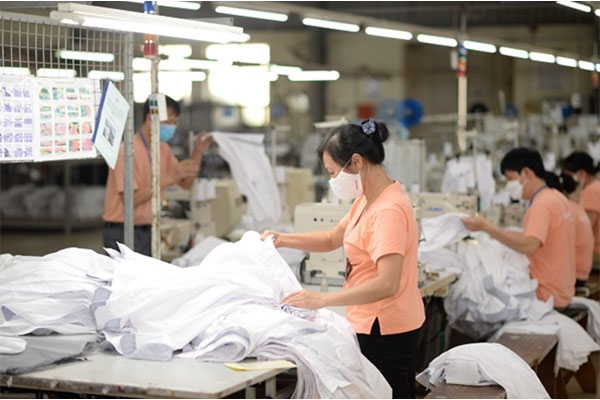
Vietnams garment manufacturing follows three primary models: CMT (Cut,Make,Trim),FOB (Free On Board),and ODM (Original Design Manufacturer).Most Vietnamese companies adopt the CMT model,producing goods using materials specified by their partners.According to research by FPTS Securities,the profit margin for this model is only 1-3%,the lowest in the value chain.Approximately 65% of Vietnams garment exports are CMT orders,30% are FOB,while ODM accounts for just 5%.
III.Impact of the Global Market
Ms.Hoang Linh,a factory manager with five years of experience at a fashion company,points out that global brands almost never allow manufacturers to choose their own material suppliers.Brands typically ensure that raw material suppliers adhere to environmental and social responsibility standards to avoid scandals.If manufacturers are permitted to source their own materials,they must hire independent auditing firms for verification—a process that can take months and conflicts with tight production schedules.
IV.Continuous Decline in Orders
At present,Vietnams textile and clothing exports have declined significantly,and enterprises have lost their market advantages.Nguyen Thi Xun Thuy,an expert with 20 years of industry research experience,pointed out that these industries cover a series of industries that provide raw materials and components for the manufacturing industry.Economic integration has promoted the industry to move towards the CMT model to make full use of Vietnams biggest advantage - cheap labor.However,this has led to the stagnation of industry growth,despite a steady increase in export volume.
V.Factory Contraction and Closures
According to Tuoi Tre,Garmex Saigon,one of the largest textile companies in Saigon,Vietnam,used to employ nearly 4,000 workers,but now only 37 are left,mainly because it has not received any orders for several months.As of September 30,2023,the number of employees of Garmex Saigon has decreased from nearly 1,900 at the end of 2022 to only 37,a significant decrease from more than 3,700 at the end of 2021.Ms.Nguyen Minh Hang,the general manager,said that due to the lack of orders,the company is barely maintaining itself through service business.

VI.Decline in Export Volume and Revenue
As the worlds second-largest garment exporter,Vietnam may face an 8% to 10% decline in textile and apparel exports this year.According to the General Statistics Office of Vietnams Data and Events report,textile exports have encountered severe challenges since the fourth quarter of 2022.From January to September 2023,Vietnams textile exports amounted to $25.51 billion,a 12.1% year-on-year decrease.Exports to the U.S.fell by 18.3%,to the EU by 13.1%,and to ASEAN by 10.5%.
Changes in the International Market Environment
One of the primary reasons for the decline in Vietnams textile exports is the global economic downturn,particularly shrinking demand in traditional markets like the U.S.EU,and Japan.Additionally,European and American clients are shifting orders to regions with more favorable geographical locations and lower labor costs,such as Central America and Africa,to reduce transportation and labor expenses.Meanwhile,markets like the EU are imposing stricter green and environmental requirements on imported textiles,along with stringent quality and sourcing standards,further complicating exports.
Potential New Systems to be Implemented by the EU
The EU is considering implementing an Extended Producer Responsibility (EPR) system for textiles.Once enacted,this system will pose greater challenges for Vietnams textile exports.It will require producers to take responsibility for environmental impacts throughout the product lifecycle,potentially increasing compliance costs and procedures for Vietnamese textile firms.
Future Prospects of Vietnams Textile Industry
Facing this complex market environment,the Vietnam Textile and Apparel Association predicts that difficulties in textile exports will continue until early 2024.A senior official of the Vietnam Textile and Apparel Industry Association said that the export value of textiles and garments in 2023 is likely to drop to $4.0-4.1 billion,a decrease compared to $4.4 billion in 2022.Despite signs of recovery starting from the second half of the year,the decline in textile and garment exports in the first nine months of 2022 decreased from 17% in the first half of the year to 13.5%.
VITAS officials anticipate that textile and apparel exports next year may improve compared to 2023.However,due to the global economic slowdown,consumers in Vietnams largest export markets—the U.S.EU,Japan,and South Korea—are tightening their budgets,putting pressure on the industry.A lack of orders has forced many export-oriented garment factories to scale back production or shut down entirely.
Overall,the challenges facing Vietnams textile and apparel industry reflect shifts in the global economic environment and evolving international market demands.Vietnam must adjust its industrial structure and development strategies to adapt to these changes and identify new growth opportunities.
Was this helpful? Give us a like!
Contact our experts for compliance audits, precise quotes, and one-stop customs support.
Recent Comments (0) 0
Leave a Reply