
US Tariffs on China: Impact on 14 Product Categories
or complex compliance issues.
clearance and fund security.
Against the backdrop of increasing global trade tensions,the United States has implemented tariff increases on 14 categories of Chinese goods,a policy change that has drawn significant attention both domestically and internationally.On May 14,2024,U.S.Trade Representative Katherine Tai announced that based on the findings of a Section 301 investigation,the U.S.would raise tariffs on a series of key Chinese product categories in response to challenges posed by China in the areas of technology transfer,intellectual property,and innovation.
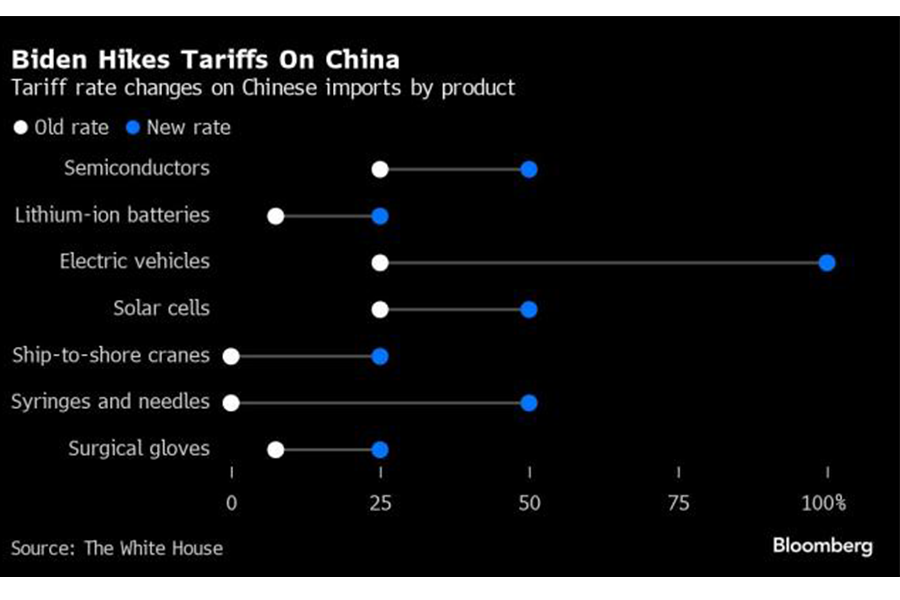
According to the statement in the announcement of the Office of the United States Trade Representative,the following is the specific list and details of the goods with newly added or increased tariffs:
Battery parts (non - lithium - ion batteries): The current tariff has been increased to 25%.
Electric vehicles: The tariff has been significantly increased from the current 25% to 100%.
Masks: The tariff will be increased to 25%.
Lithium - ion electric vehicle batteries: The tariff has been increased to 25%.
Lithium - ion non - electric vehicle batteries: The tariff will be increased to 25% in 2026.
Medical gloves: The tariff for this category of goods will be increased to 25% in 2026.
Natural graphite: The tariff will be increased to 25% in 2026.
Other critical minerals: The tariff has been immediately increased to 25%.
Permanent magnets: The tariff will be increased to 25% in 2026.
Semiconductors: The tariffs will be raised to 50% in 2025.
Ship - to - shore cranes: The tariff has been immediately increased to 25%.
12.Batteries (whether assembled into modules or not): The tariff has been increased to 50%.
Steel and aluminum products: The tariff has been immediately increased to 25%.
Syringes and needles: The tariff will be increased to 50% in 2026.
This policy adjustment was made after a year - long review of the tariff policy.This review is a follow - up action to the tariffs imposed on approximately $300 billion worth of goods imported from China during the Trump administration.Tai emphasized that this adjustment is to protect the US technology industry and promote fair trade,while also responding to the demands of domestic industries for the continuation of these tariff actions.
The US government also announced that it will establish an exclusion process for equipment used in domestic manufacturing and has proposed 19 exclusion recommendations for specific solar manufacturing equipment.This indicates that the US will still provide flexibility in certain key areas when implementing these tariff policies.
In terms of countermeasures,the Office of the United States Trade Representative will strengthen cooperation with domestic private companies to combat technology theft and will allocate additional funds to the US Customs and Border Protection to enhance the enforcement of Section 301 actions.This series of measures demonstrates the USs strategic adjustments on the global trade stage and its strict management of trade policies.In response,a spokesperson for the Chinese Ministry of Commerce expressed strong dissatisfaction and firm opposition at a press conference,believing that the USs actions seriously violate international trade rules and accusing the US of politicizing economic and trade issues.The Chinese side promised to take necessary measures to defend its rights and interests,which may mean that Sino - US trade relations will face further tensions.
Brazils cotton exports to China surged by 950%
Was this helpful? Give us a like!
Contact our experts for compliance audits, precise quotes, and one-stop customs support.
Recent Comments (0) 0
Leave a Reply