
EU BPA Ban: Impact on Food Contact Materials
or complex compliance issues.
clearance and fund security.
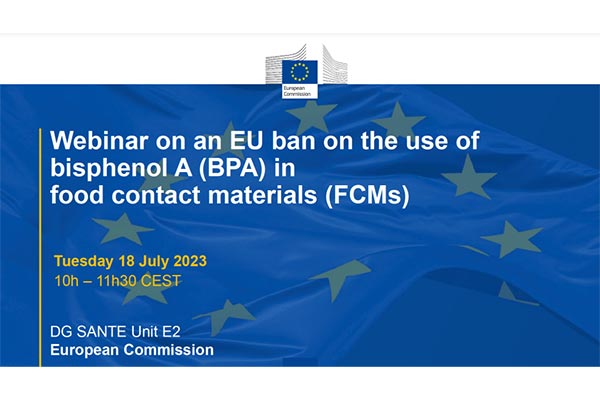
On July 18,2023,the European Union’s Directorate-General for Health and Food Safety (DG Sante) announced that it will ban the intentional addition of bisphenol A (BPA) and its related substances,including bisphenol S,bisphenol F,and 2,2-bis(4′-hydroxyphenyl)-4-methylpentane,to food contact materials.This ban is based on the latest safety assessment of BPA by the European Food Safety Authority (EFSA).The ban is expected to come into effect in the spring of 2024,with an 18-month transition period.
I.Basis for the EU Ban on Bisphenol A
In a safety assessment report released on April 23,2023,the European Food Safety Authority (EFSA) set the tolerable daily intake (TDI) of BPA at 0.2 ng/kg body weight/day based on the latest scientific data.
Due to the new TDI setting,the specific migration limit (SML) of 0.05 mg/kg for BPA under EU Food Contact Plastic Regulation 10/2011 will no longer apply.
Therefore,DG Sante has decided to prohibit the intentional addition of BPA in all food contact materials,including plastic monomers,coatings and varnishes,inks,adhesives,and rubber.
II.Cases of Non-Intentional Addition
DGSante listed several scenarios that fall under non-intentional addition,including contamination from raw material streams,introduction via "vapor phase transfer" from other materials,environmental pollution,and other unknown sources.
III.Enterprise Countermeasures
DG Sante recommends that food contact material manufacturers plan ahead to replace BPA-synthesized polycarbonate or polysulfone,such as using PET,HDPE,PP,and other materials.
For coatings and varnishes,the ban on BPA may affect product shelf life,increasing costs and energy consumption.
IV.Implementation Date and Transition Period
1.The ban is expected to come into effect in the spring of 2024,with an 18-month transition period.This means that food contact materials containing bisphenol A will be prohibited from entering the EU market between the end of 2025 and the beginning of 2026.
The industry can apply for an extension of the phase-out period by September 15,2023.
V.Restrictions on Bisphenol A in Other Countries/Regions
China allows the use of BPA in plastic resins,coatings and varnishes and their additives,as well as adhesive additives,with an SML of 0.6 mg/kg,and prohibits its use in the production of food contact materials and products specifically for infants and young children.
The U.S.Food and Drug Administration (FDA) has not set limits on the addition of BPA in food contact materials but prohibits its use in infant food contact materials.In 2022,the FDA began re-evaluating the safety of BPA in food contact materials.
Was this helpful? Give us a like!
Contact our experts for compliance audits, precise quotes, and one-stop customs support.
Recent Comments (0) 0
Leave a Reply